As a marketer, you have to be scanning for trends constantly and you have to be prepared for anything. We live in a world that is moving fast, and in a world of social media it is even faster. Viral trends can come and go in just a couple of days, so you have to be constantly ready.
But is it possible to spot those trends before they become trends?
Let’s take a look at a viral moment from September 2025 that I observed on the Czech market.
The case: Lidl’s hazelnut spread goes viral
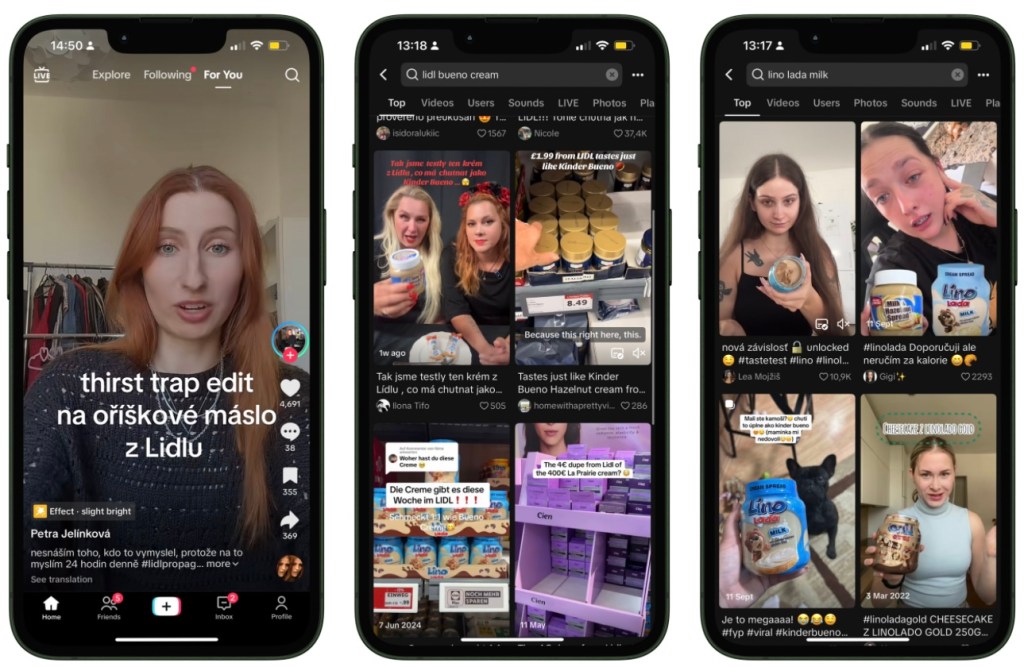
A video appeared on TikTok showing a nut spread cream from Lidl, with the claim that it tasted exactly like Kinder Bueno. People immediately jumped on that video, and soon a wave of taste test clips flooded TikTok.
Within days, the spread was sold out. Audiences then pivoted to a substitute- Lino Lada Milk– claiming it was even better, like the inside of Kinder Happy Hippo. Stores were taken by storm and shelves were cleaned out again.
The product went fully viral: recipes, reaction videos, and reviews kept multiplying until it was impossible to find a jar anywhere.
How TikTok works?
TikTok uses AI to analyze your behavioral patterns and, based on them, serves you content on your For You Page (FYP).
„In general, these systems suggest content after taking into account user preferences as expressed through interactions with the app, like posting a comment or following an account. These signals help the recommendation system gauge the content you like as well as the content you’d prefer to skip.”(TikTok newsroom)
Factors influencing FYP include:
- Video quality
- Completion rate
- Engagement metrics
- Video information (captions, hashtags, sounds)
- Interaction with trends and influencers
- App usage patterns
- Device and account settings
- Trending content & user preference
(Pollock, 2025)
Psychology levers behind the viral
Let’s take a look at the psychology levers that made this video and product go viral:
- Social proof– term coined by Doctor Cialdini that describes the human tendency to follow the actions and opinions of others to guide one’s own behaviour. People assume that the majority’s actions are correct, and seeing that others have already chosen a particular option provides validation and builds trust (The Decision Lab / The Decision Lab). In digital marketing this takes the form of reviews, testimonials, ratings, influencer endorsement, awards, and certifications. (Byrska, Hylewski, 2025)
- Word-of-Mouth (WOM)– word of mouth reffers to person to person communication, often involving the sharing of information about products or experiences. Because these recommendations come from trusted peers, they are considered highly authentic, credible, and influential, driving interest, leading to new customers, and building brand loyalty more effectively than traditional, company-controlled advertising. (Sumup, NA)
- Bandwagon effect– a psychological phenomenon where people adopt certain behaviours, beliefs, or styles because a growing number of others are doing so. This tendency to “jump on the bandwagon” stems from a desire to fit in, be part of a group, or avoid being left out, influencing decisions in consumer behaviour, politics, and social trends. The perceived popularity of an idea or action makes people feel that this must be a good choice. They want to feel included and accepted by their peers, and so they jump on the bandwagon and follow- in our case, the trend. (Shatz, Phd., NA)/ (Ungvarsky, 2023)
- Conformity bias– the psychological tendency for an individual to align their beliefs, attitudes, and behaviors with those of a group, either to fit in, gain approval, or because they assume the majority is correct. This can lead people to adopt opinions or actions that contradict their own judgment, driven by real or perceived social pressure from others. (Nikolopoulou, 2024) Marketers use these tactics, including highlighting best-selling products and creating viral challenges, to satisfy the innate human tendency to conform, reducing individual risk and providing a sense of belonging or correctness. (Shikhrakar,2020)
- FOMO (Fear of Missing Out)– a psychological tactic that creates a sense of urgency and a desire to act quickly before a potentially valuable opportunity is missed. Marketers use FOMO by highlighting limited-time offers, scarce supply, or exclusive access to encourage immediate purchases and increase sales, playing on the universal human tendency to avoid regret and stay connected to what others are doing.(Byrska, Targosz, 2025)
- Curiosity gap– is a theory that curisosity is a drive to close a gap between what a person currently knows and what they want to or need to know. (Kidd, Hayden, 2015)
- Herd behavior– in psychology this refers to individuals adopting the same behaviour as the majority, often influenced by a desire to fit in, fear of social pressure or missing out, or perceived „wisdom of the crowd“ rather than independent thought. (Nguyen, 2024) This can be seen across various industries and social situations, in consumer trends it is people purchasing products because they are popular.
- Scarcity principle– peopel perceive things as more valuable and desirable when they are in limited supply or appear rare. (Ulster,NA)
- Network effects – refers to the concept that the value of a product, service, or even a relationship increases as more people use or participate in it .(Anomaly, Jones, 2025)
| Lever | How it showed up in this case |
|---|---|
| Curiosity gap | “Tastes like Kinder Bueno” → people had to test it. |
| Social proof / WOM | Taste tests, reviews, and recommendations spread fast |
| Bandwagon effect | More joined once they saw others doing it. |
| Conformity bias | People aligned with the group that said “it’s amazing.” |
| FOMO & scarcity | Sold-out jars made people rush to buy. |
| Low cost to try | Cheap jar = easy impulse purchase. |
| Algorythm boost | TikTok pushed videos with engagement to the FYP. |
| Network effects | Each new participant made the trend bigger. |
How it played out
So how did all of this play out if we take a look at the psychological principles and effects taking place?
It all started with possibly one video (it’s hard to trace down the patient zero 😅) of a person claiming: “Hey, I got this spread from Lidl that tastes exactly like Kinder Bueno.”
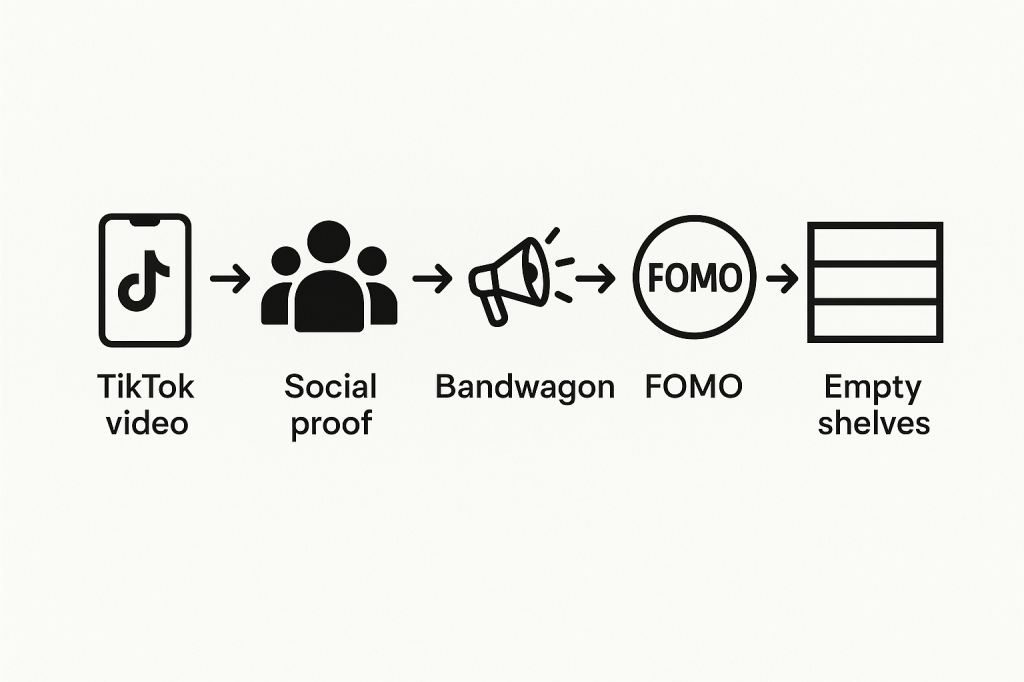
This activated social proof– people believed the review, the word of mouth that this product was great. And this triggered their curiosity to go check it out. As more people were sharing their experience and creating more social proof, others jumped on the bandwagon, and their FOMO was yelling: “Hey, don’t be left out! It’s amazing- see how many people claim it’s amazing, go for it too!”
This resulted in the product being almost gone, and people grabbing a substitute in the form of Lino Lada Milk, which then triggered the scarcity principle. People were running to shops to buy it before it was gone, while more videos appeared claiming it was almost sold out.
And last but not least- the more people were using this product, the more valuable it became, the more users it attracted, and the more it grew.
And we ended up with a viral video and a sold-out product.
Lessons for marketers
- Trend spotting: Watch TikTok daily, track hashtags, monitor repeat mentions.
- Stock readiness: Secure supply as soon as you see a spark.
- Creative assets: Have templates ready so you can publish instantly.
- Speed: If you’re slow, you miss the wave.
- Peak timing: Announcing “we still have it” when others are sold out can be your winning move.
- Afterlife: Retarget engaged audiences and extend the story with recipes, hacks, or bundles.

Conclusion
The Lidl/Lino Lada case shows how one small video can spiral into national virality almost overnight. Psychology (social proof, curiosity, FOMO) + TikTok’s algorithm + low barriers to participation = empty shelves.
Virality is unpredictable. But readiness is not. Brands that listen, stock, and act fast are the ones who ride the wave- everyone else is left behind.
Refferences
Agorapulse, 2025. TikTok algorithm: What you need to know. Written by Pollock. [online] Agorapulse. Available at: https://www.agorapulse.com/blog/tiktok/tiktok-algorithm/ [Accessed 27 September 2025].
Anomaly, J. and Jones, M., 2020. Network effects and social value. Philosophia, 48(3), pp.873–892. [online] Springer. Available at: https://link.springer.com/article/10.1007/s11406-020-00189-3#citeas [Accessed 27 September 2025].
Byrska, M. and Targosz, K., 2025. FOMO in digital marketing. [online] Landingi. Available at: https://landingi.com/digital-marketing/fomo/ [Accessed 27 September 2025].
Decision Lab, T., n.d. Herd behaviour in finance: the sheep in the stock market. Written by Nguyen, 2024. [online] The Decision Lab. Available at: https://thedecisionlab.com/insights/finance/the-sheep-in-the-stock-market [Accessed 27 September 2025].
Decision Lab, T., n.d. Social proof. [online] The Decision Lab. Available at: https://thedecisionlab.com/reference-guide/psychology/social-proof [Accessed 27 September 2025].
Effectiviology, n.d. The bandwagon effect. Written by Shatz, I. [online] Effectiviology. Available at: https://effectiviology.com/bandwagon/ [Accessed 27 September 2025].
EBSCO, 2023. Bandwagon effect. Written by Ungvarsky, J. [online] EBSCO Research Starters. Available at: https://www.ebsco.com/research-starters/social-sciences-and-humanities/bandwagon-effect [Accessed 27 September 2025].
Hylewski, M. and Byrska, M., 2025. What is social proof in digital marketing? Last updated August 12, 2025. [online] Landingi. Available at: https://landingi.com/digital-marketing/social-proof/ [Accessed 27 September 2025].
Kidd, C. and Hayden, B.Y., 2015. The psychology and neuroscience of curiosity. Neuron, 88(3), pp.449–460. [online] PubMed Central. Available at: https://pmc.ncbi.nlm.nih.gov/articles/PMC4635443/ [Accessed 27 September 2025].
Nikolopoulou, K., 2023. Conformity bias. Published 5 March 2023. Revised 10 April 2024. [online] Scribbr. Available at: https://www.scribbr.com/research-bias/conformity-bias/ [Accessed 27 September 2025].
Shikhrakar, S., 2020. Conformity bias in UX. Published 16 March 2020. [online] UX360. Available at: https://ux360.design/conformity-bias-ux/ [Accessed 27 September 2025].
SumUp, n.d. Word of mouth. [online] SumUp. Available at: https://www.sumup.com/en-gb/invoices/dictionary/word-of-mouth/ [Accessed 27 September 2025].
Ulster University, n.d. Supply and demand: The scarcity principle. [online] Ulster University. Available at: https://qa.ulster.ac.uk/blog/supply-and-demand-the-scarcity-principle/ [Accessed 27 September 2025].
 Barbora Cizkovska
Napsat komentář