Lately, I’ve been collecting ads that look suspiciously similar.
Not because I think AI is bad.
I use AI too.
But there is a difference between using AI as a creative tool and letting the tool make the creative decisions for you.
Because apparently we’ve entered the era of:
giant headline + colourful blob + generic AI people + 14 pieces of information + five icons + giant CTA + gradient + somehow everything is important
And when everyone uses the same tools in the same way…
everyone starts looking the same.
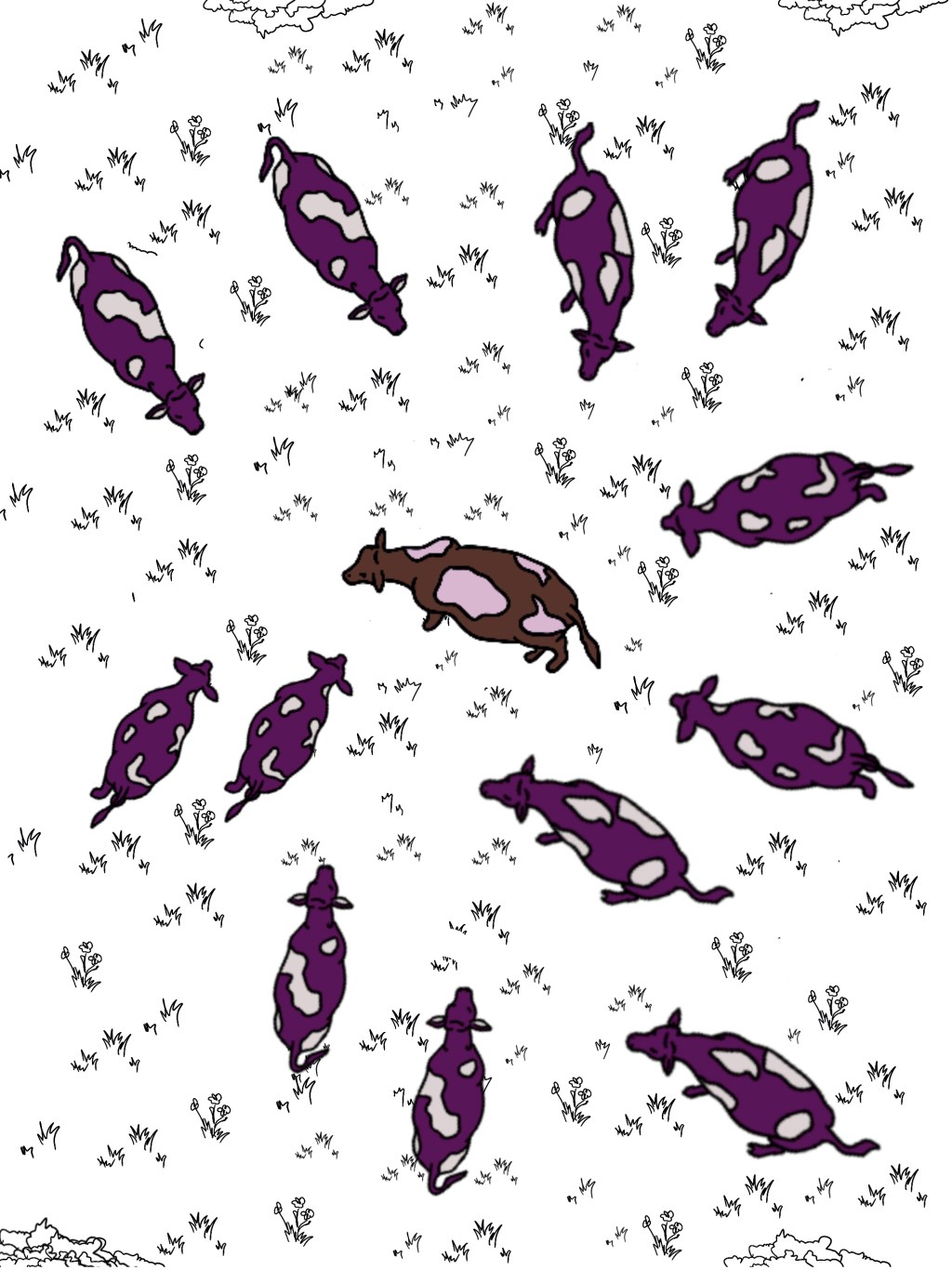
Which made me think of Seth Godin’s Purple Cow.
The whole idea is that when you’re surrounded by ordinary cows, the remarkable one gets your attention. Something worth noticing. Something worth talking about.
But what happens when everybody becomes the Purple Cow?
At some point, the Purple Cow isn’t remarkable anymore.
The brown cow becomes interesting.
And honestly, that’s where I think we’re heading.
Because I’m scrolling Instagram on a phone.
I’m not reading your miniature brochure.
I’m not studying your 17-point infographic.
And I’m definitely not remembering your brand because you managed to fit another three selling points into the bottom corner.
Good design isn’t about fitting everything in.
It’s about knowing what doesn’t need to be there.
That’s literally what a good designer/marketer is supposed to do.
And this is also why the Penny ad caught my attention.
They already had the actors.
They already had a real campaign concept.
They had actual people who presumably represent the campaign.
And then… why generate the people?
You could photograph the actors and build the environment around them. You could photograph the animals. You could work with the charity. You could create something that actually belongs to that campaign.
Instead, you get something that looks like it could belong to literally any brand.
And that’s the bigger problem for me:
AI can make production faster.
It cannot replace taste, judgment, art direction or brand thinking.
There is even emerging research pointing in the same direction: studies have found links between perceived AI authorship and lower perceptions of authenticity, trust and consumer response in some marketing contexts — while the effects can be different when AI is used for editing or more factual communication rather than replacing the human voice.
So no, I’m not saying:
“Don’t use AI.”
I’m saying:
Use it smart.
Use it when you don’t have a studio for a personal case study.
Use it to explore an idea.
Use it to speed up production.
Use it as a starting point.
But if you’re a brand with actual products, actual customers, actual employees, actual locations and an actual story…
maybe don’t replace all of that with the same AI aesthetic everyone else is using.
Because eventually, when everything looks artificial, real starts looking remarkable again.
And maybe the next Purple Cow isn’t purple.
Maybe it’s just a brown cow that looks real . 🐄

Read more here:
Godin, S. In praise of the purple cow. Available at: https://www.fastcompany.com/46049/praise-purple-cow?utm_source=chatgpt.com
Majerova, J.; Nadanyiova, M.; Patik, L. One step forward, two steps back: AI generated content vs. perceived trust, authenticity and credibility. Available at: https://ojs.mruni.eu/ojs/intellectual-economics/article/view/9114?utm_source=chatgpt.com
Kirk, P. C.; Givi, J. The AI-authorship effect: Understanding authenticity, moral disgust, and consumer responses to AI-generated marketing communications. Available at: https://www.sciencedirect.com/science/article/abs/pii/S0148296324004880?via%3Dihub


Zanechat odpověď