The Body Shop
The Body Shop was founded by Anita Roddick in 1976 and quickly became known for challenging the beauty industry’s traditional approach through activism, ethical sourcing and conscious branding. Roddick built the brand around a strong personal philosophy, using The Body Shop as a platform for activism rather than simply selling beauty products (Entine, 2002).
The brand’s decline began to accelerate after its sale to L’Oréal, which many consumers perceived as conflicting with the values The Body Shop represented. Competitors such as Lush had already begun developing their own distinctive ethical positioning by the late 1990s (Entine, 2002). Further ownership changes continued to weaken the connection between the brand and its original purpose.
The Body Shop is now owned by the Aurea Group (Butler, 2024). It still has strong brand recognition and residual goodwill, with 77% of consumers perceiving it as sustainable (Hoves, 2025). However, its audience has aged alongside the brand, while younger consumers have increasingly moved towards more digitally engaging and science-led alternatives (Kilikita, 2024). The brand has struggled to keep pace with changing trends and attract new customers (BrandVision, 2026).
The opportunity
The Body Shop was once radically different. Today, ethical and sustainable positioning is no longer enough to make a beauty brand distinctive. Sustainability has become an increasingly important consideration across the beauty market, while competitors have developed stronger digital experiences, storytelling and product innovation (Statista, 2025).
The result is a perception problem.
The Body Shop is increasingly associated with an older generation: the brand your grandmother used, the familiar product you received as a Christmas gift, or the scent you remember from growing up. Its heritage gives it recognition, but it can also make the brand feel dated to younger consumers.
The opportunity is not to turn The Body Shop into a completely different brand. It is to make it relevant to a new generation.
Younger consumers are particularly relevant to this shift. Research shows that 82% of Gen Z express concern about the state of the planet, 72% have changed their behaviour to reduce environmental impact and 62% prefer to buy from sustainable brands. Additionally, 91% are more likely to switch to brands that support a good cause (alfred24, 2024).
But reaching a younger audience requires more than changing the communication.
It requires changing the experience.
The digital opportunity
Beauty is inherently sensory. In a physical store, customers can pick up a product, smell it, test its texture and see how it applies. E-commerce removes much of that experience.
The digital experience therefore needs to compensate.
Product imagery plays an important role in online purchase decisions, with 67% of consumers considering it the most important factor, above product descriptions (MDGadvertising, n.d.). Short-form video and guided selling can also help customers find suitable products and visualise the experience before purchasing (Zoovu, 2026).
This led me to one central question:
How can The Body Shop make trying an unfamiliar product feel less risky?
Proof before commitment
One of the barriers identified around The Body Shop is perceived value. Some consumers consider the brand expensive, while others question whether its products are worth the price.
Asking a new customer to immediately purchase a full-size product therefore creates unnecessary risk.
Instead, The Body Shop could let customers experience the products first.
Proof before commitment.
Sampling can reduce the uncertainty around trying an unfamiliar beauty product by allowing consumers to experience it before making a larger purchase. This is particularly relevant to beauty, where texture, application, scent, and suitability are difficult to evaluate through a screen alone (Zacros, n.d.).
A sample gives customers first-hand knowledge of the product rather than asking them to rely entirely on advertising, descriptions or other people’s opinions. If the product delivers on what the brand promised, the experience itself becomes proof and can strengthen confidence in the brand (Chan, 2023).
Low-risk entry
Discovery boxes, samples and trial-sized products could introduce customers to the range without requiring a full-size purchase.
The objective is not simply to offer a cheaper way to buy the product.
It is to make trying something unfamiliar less risky.
If the customer likes the product, experiences its quality and finds that it works for them, the full-size purchase becomes an easier decision.
The Body Shop could build this around its existing hero products, turning sampling into the first step in discovering the brand rather than simply another promotional tactic.
Product performance
The same principle applies to the digital presentation of the products.
Don’t just show the packaging.
Show the texture.
Show the application.
Show the ingredients.
Show the result.
The product itself should become the proof.
Short-form video, detailed product imagery and guided product discovery can help recreate some of the experience normally provided by a physical store and give customers more confidence before purchasing (Zoovu, 2026).
Samples can also create a more direct relationship with the product. Once customers have actually tried it, they can form their own opinion rather than relying entirely on reviews or advertising. This can also give them something real to share with other consumers (Chan, 2023).
Making the products look as good online as they deserve
The visual identity should support this experience.
The goal is not simply to make The Body Shop look more premium. It is to make the products more tangible, desirable and understandable through a screen.
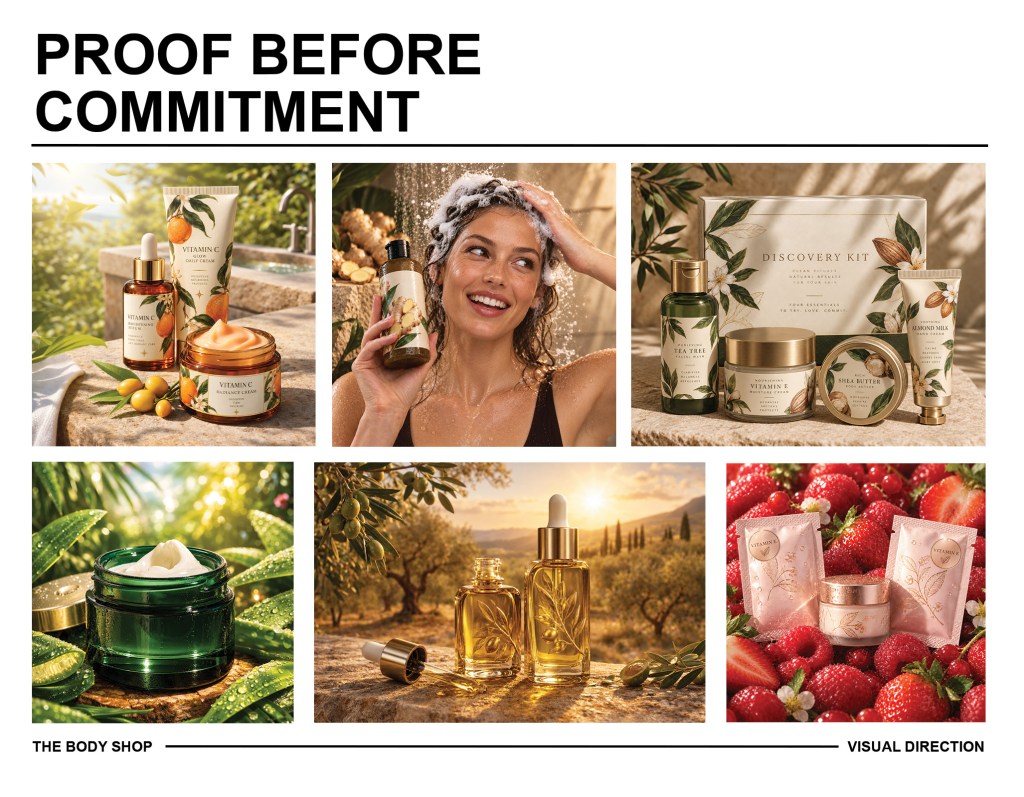
The proposed visual direction focuses on five elements:
Ingredient-led
Show the ingredients and where the product comes from.
Sensory
Make texture, water, cream, botanicals and application visible.
Editorial
Present everyday beauty products with the visual confidence of a modern beauty campaign.
Human
Show products being used rather than simply displaying the packaging.
Digital-first
Create imagery that works across e-commerce, social media and digital campaigns.
The result is a visual language that puts the products first while making the online experience more engaging.
The product should do the talking.
Refferences:
Alfred24. (2024); Gen Z: the Eco Conscious Generation. Available at: https://alfred24.com/gen-z-the-eco-conscious-generation/#:~:text=In (Accessed: 8 February 2026)
Bailey GP, (2022); What Is the Difference Between a Brand’s Purpose and Its Value Proposition?. Available at: https://baileygp.com/article/what-is-the-difference-between-a-brands-purpose-and-its-value-proposition/#:~:text=Brand%20purpose%20defines%20why%20you,might%20do%20in%20the%20future. (Accessed: 8 February 2026)
Brand Vision, (2024, updated 2026); An Analysis Of The Rise and Fall of The Body Shop, Its Rebranding, and Marketing Strategies. Available at: https://www.brandvm.com/post/the-body-shop-rebranding-and-marketing (Accessed: 6 April 2026)
Butler, Sarah. (2024); Body Shop is back for good … and back in profit, new boss tells staff. Available at: https://www.theguardian.com/business/2024/dec/19/body-shop-is-back-for-good-and-back-in-profit-new-boss-tells-staff (Accessed: 6 April 2026)
Chan, James. (2023); The Importance of Beauty Samples In A Digital World. Available at: https://www.odore.com/blog/the-importance-of-beauty-samples-in-a-digital-world (Accessed: 3 September 2026)
Entine, John. (2002); body flop. Available at: https://www.theglobeandmail.com/report-on-business/rob-magazine/body-flop/article1023718/#:~:text=It%20was%20still%20the%20best,that%20framed%20Anita%20almost%20perfectly (Accessed: 6 April 2026)
Hoves, Olivia. (2025)); Green brands: The Body Shop. Available at: https://www.which.co.uk/reviews/shopping-sustainably/article/green-brands/green-brands-the-body-shop-aIl3V1G950rd (Accessed: 6 April 2026)
Kilikita, Jacqueline. (2024); Where Did It All Go Wrong For The Body Shop?. Available at: https://www.refinery29.com/en-us/what-happened-to-the-body-shop (Accessed: 6 April 2026)
MDGsolutions. (n.d.); It’s All About the Images [Infographic]. Available at: https://www.mdgsolutions.com/learn-about-multi-location-marketing/its-all-about-the-images-infographic/ (Accessed: 6 April 2026)
Statista. (2025); The Body Shop – statistics & facts. Available at: https://www.statista.com/topics/12229/the-body-shop/?srsltid=AfmBOopYMOY5N51mumlL71dJz56WgkHPazcUo5HDdqjVyZXahHndxQoN#topFacts (Accessed: 6 April 2026)
Zacros. (n.d.); Beyond the Sachets: How Cosmetic Sample Packaging Are Transforming Beauty Marketing. Avalaible at: https://www.zacrosamerica.com/news/beyond-the-sachets/ (Accessed: 3 September 2026)
Zoovu. (2026); How beauty brands are turning to guided selling to win online. Available at: https://zoovu.com/blog/digital-technologies-beauty-sector (Accessed: 6 April 2026)
List of Figures
AI-generated conceptual visuals created for this editorial. Products and packaging shown are fictional, unbranded, and do not represent actual The Body Shop products or campaigns.
1. Vitamin C — luxury citrus skincare
No-name editorial showing off: A high-fashion skincare still life featuring three unbranded Vitamin C products — a luxurious serum dropper bottle, cream tube and open face cream jar — arranged on a sunlit stone surface beside fresh yellow-orange citrus fruit and green leaves. Warm golden sunlight, elegant packaging, refined botanical details, Mediterranean garden setting, soft background blur and premium beauty campaign aesthetic.
2. Ginger — editorial haircare
No-name editorial showing off: A high-fashion beauty editorial featuring a woman washing her hair under a shower, her blonde hair covered in rich white foam while she holds an unbranded ginger anti-dandruff shampoo bottle. Fresh ginger roots and green leaves appear in the background, with water droplets, warm golden lighting, wet skin, cinematic composition and luxurious natural haircare campaign styling.
3. Discovery Kit — luxury skincare samples
No-name editorial showing off: A high-end skincare discovery kit featuring four unbranded sample-size products — tea tree facial wash, vitamin E moisturizer, shea butter body butter and almond milk hand cream — arranged in front of an elegant cream discovery-kit box. Botanical leaves, flowers and subtle gold details decorate the packaging, with warm sunlight, stone textures, earthy neutrals and sophisticated luxury beauty editorial styling.
4. Olive Oil — Mediterranean facial oils
No-name editorial showing off: A luxurious Mediterranean skincare editorial featuring two unbranded amber glass facial-oil dropper bottles, one open with its pipette lying beside it and oil glistening on the stone surface. Olive branches, fresh green olives and a cut olive surround the products, with a golden sunset, rolling hills, cypress trees and an atmospheric olive grove in the background. Rich amber tones, cinematic sunlight and ultra-premium skincare campaign aesthetic.
5. Aloe — luxury botanical skincare
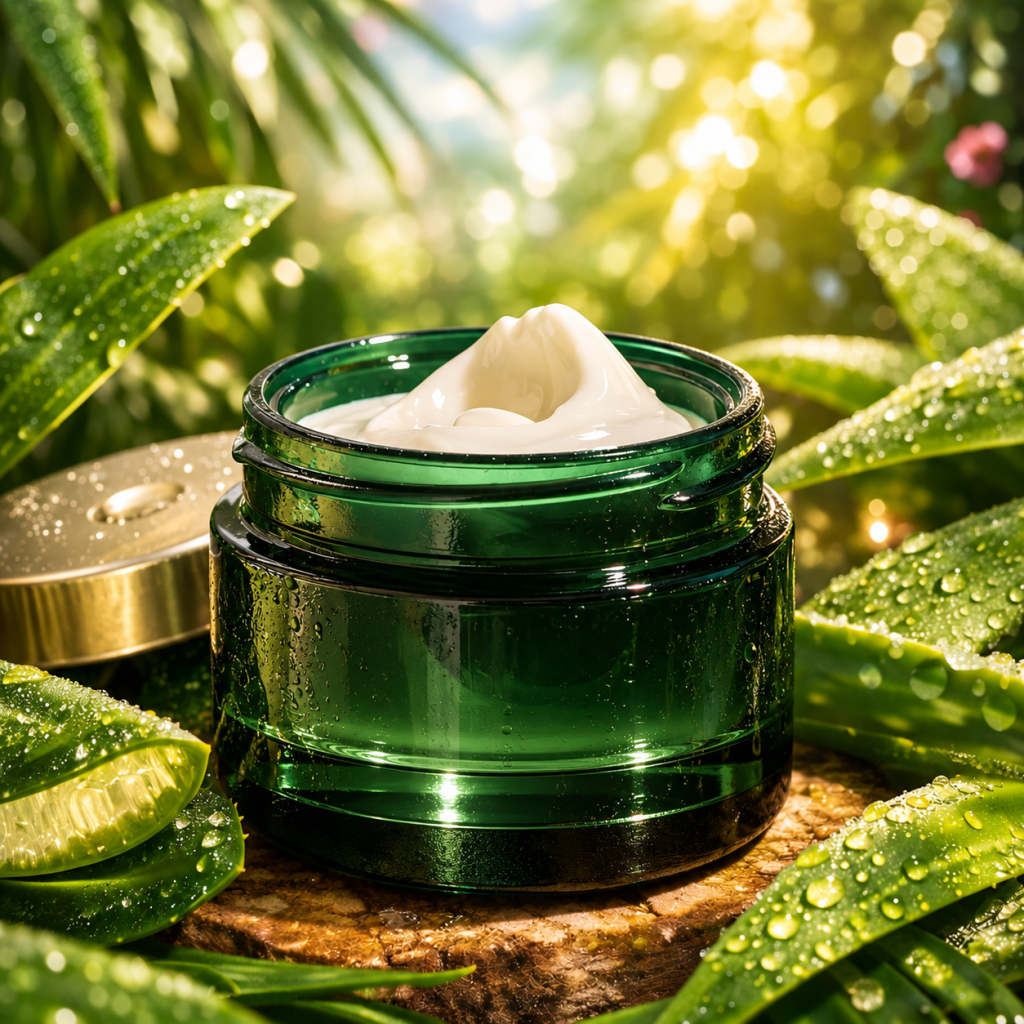
No-name editorial showing off: A high-fashion botanical skincare close-up featuring an unbranded dark emerald-green glass jar filled with rich white aloe cream. The open jar sits on natural stone surrounded by fresh aloe leaves, translucent aloe slices and glistening water droplets. Lush tropical greenery, warm sunlight, golden bokeh and dramatic shallow depth of field create an elevated luxury spa and skincare campaign aesthetic.
6. Vitamin E — berry skincare samples
No-name editorial showing off: A luxurious Vitamin E skincare sample editorial featuring two elegant blush-pink unbranded sachets and a small frosted cream jar with a refined metallic lid, surrounded by fresh raspberries, strawberries, redcurrants and delicate white flowers. Everything is covered in tiny water droplets, creating a fresh antioxidant-inspired feeling. Rich berry tones, soft pink packaging, warm highlights, macro photography and sophisticated high-fashion beauty campaign styling.


Zanechat odpověď